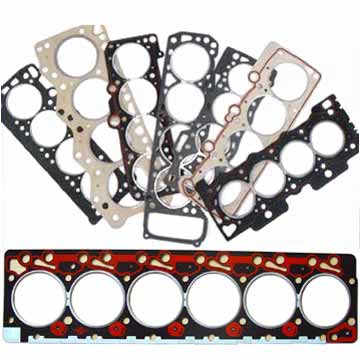
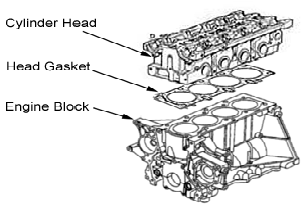
One thing no engine builder wants to worry about is a head gasket failure. Stock head gaskets hold up well enough under normal loads. But as compression ratios and combustion pressures go up, a stock head gasket may not be able to maintain a leak-free seal. And once hot combustion gasses start blowing past the gasket's combustion armor, bad things begin to happen. The combustion armor cracks or burns through, compression is lost and the gasket fails. Or, oil and coolant start finding new ways to circulate inside the engine, often with negative consequences. One of the hottest products to emerge in recent years for high performance engines are Multi-Layer Steel (MLS) head gaskets. MLS head gaskets have become the gasket of choice for many forms of racing because they have what it takes to handle the pressure without leaking, blowing out or burning through.
WHY MLS?
The latest alternative to reinforced composite head gaskets and copper
head gaskets for performance engines are MLS gaskets. Unlike these other
types of gaskets, MLS gaskets use a different strategy to seal the
combustion chamber. They typically use 3 to 5 layers of stainless steel
to create a spring-like effect that seals the gap between the head and
block.
As engine compression, rpm and combustion pressure go up, the cylinder
head is pushed away from the block every time the cylinders fire. The
movement isn't enough to be seen with the naked eye, but it can be
measured - and it can be enough to break the seal between the head and
block with conventional gasket designs. The amount of lift depends on
cylinder pressures and how much the head bolts stretch.
To maintain the seal when the head is pushed up and away from the block,
the head gasket has to expand as the head lifts. This requires a
certain amount of springiness or elasticity that can only be achieved
with an MLS head gasket.
The multi-layer construction of MLS head gaskets allows the inner
layer(s) to act something like a valve spring. As the head lifts away
from the block, the inner layer(s) of the gasket push the outer layers
apart to maintain the seal. The spring steel expands and contracts
without taking a permanent set or deforming under load, and the gasket
maintains its seal. That's why MLS gaskets have more "vertical recovery"
than other types of gaskets and can handle high pressure applications.
In a stock engine, the maximum combustion pressures may only reach about
1,000 psi. But in a performance engine, they can reach 1,500 to 2,200
psi under race conditions, and soar as high as 3,500 psi if the engine
goes into detonation. The higher the pressure, the greater the cylinder
head separation from the block - and the more the gasket has to expand
and contract to maintain its seal.
Aftermarket MLS performance gaskets are engineered for racing and are
not just copies of the OEM style MLS gaskets. They have strategically
placed sealing beads around the combustion chambers and coolant passages
to concentrate clamping loads in the most critical areas. Some MLS
gaskets have an additional stainless steel "stopper ring" to further
increase sealing pressure around the combustion chambers (such as in
Chevy LS1/LS6 engines). One gasket supplier also has a line of MLS
performance gaskets that incorporate a unique "gas-filled ring" around
the combustion chambers. The pressure inside the ring is 600 to 700 psi,
and increases as the engine heats up to increase the clamping load and
combustion seal. Features like these have enabled MLS gaskets to become
the gasket of choice for many forms of racing as well as street
performance applications.
The all-steel construction of MLS gaskets makes them almost bullet-proof
under even the most extreme operating conditions. The gaskets also have
an exterior "Viton" or polymer coating that helps them cold seal on
less than ideal surfaces. Most original equipment MLS require extremely
smooth finishes (20 to 30 Ra) to seal. Most performance MLS gaskets
require a surface of 50 Ra or less, and some have thicker coatings that
can accommodate surface finishes as rough as 60 Ra.
As for reusability, MLS gasket suppliers say MLS gaskets should not be
reused because the embossing may not fully recover once the gasket has
been through a thermal cycle. But as long as the gasket appears to be in
good condition when it is removed, many racers find they can reuse MLS
gaskets with no problems. And if the surface coating has a damaged spot
or two, it can often be repaired with a light coating of RTV silicone.
Many racers who used to run copper heads gaskets have switched to MLS
because the gaskets hold up just as well and don't have the sealing or
installation issues associated with copper gaskets. The only drawback
with MLS gaskets are their price.
The multi-layer construction of MLS head gaskets requires expensive
precision tooling, and 3 to 5 layers of stainless steel, so some
customers might balk at the cost. Even so, considering the durability
these gaskets are capable of providing, paying top dollar for a gasket
that won't blow out or fail is more than worth the money. And unlike
composition gaskets that cannot be reused, MLS gaskets don't have to be
replaced every time the head comes off the engine.
Head gasket re-torquing
Stock replacement head gaskets do not generally need re-torquing. Steel shim head gaskets should be retorqued. Racing engine head gaskets should be re-torqued regardless of the type of gasket being used. If your engine calls for Torque-to-yield head bolts (TTY) do not re-torque.
The purpose of re-torquing the cylinder heads is to restore the proper stretch to the head bolts after the first heat cycle. Physics dictates that the engine assembly will expand as the engine temperature increases, this expansion will increase the compressive load on the head gaskets causing a seating effect sometimes referred to as creep relaxation in composite head gaskets.
The seating of the gaskets and threads results in a commensurate relaxation of the head bolts when the engine cools. Re-torquing the head bolts/studs restores the proper stretch to the fasteners which will insure proper cold sealing of the gaskets as well as proper combustion sealing under full load.
One re-torque is all that is necessary (unless the manufacturers
instructions indicate otherwise), subsequent re-torquing can cause
plastic deformation (stretch) of the head fasteners and damage to the
head gaskets.
The process for re-torquing is as follows:
Start the engine & run with no load until operating temperature is reached.
Shut down the engine & let cool completely (overnight).
Retracing the original torque pattern, one fastener at a time, loosen
slightly to overcome the friction set of the bolt or nut, then re-torque
to specified torque setting.
It is suggested by some to retorque cast iron heads/blocks while still warm (not hot). This should NOT be done with aluminum blocks or heads.
