If the counterweights are the correct weight to offset the weight of the
rods and pistons, the crankshaft is balanced. If the counterweights are
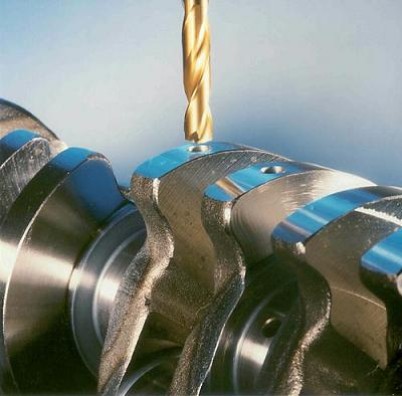
too heavy, material must be removed by drilling or milling the
counterweights. If the counterweights are too light, weight must be
added to the counterweights. This is usually done by drilling a hole in
the counterweight and filling the hole with "heavy metal" or "mallory".
This filler metal is denser and heaver than steel (but not stonger) so
the weight of the counterweight will increase as a result.
Internal Balance & External Balance
When the counterweights alone can be made to balance the crankshaft, the
crank is said to be "internally balanced". If the counterweights are
too light by themselves to balance the crankshaft and more weight is
needed, an "external balance" can be used. This involves a harmonic
dampener or flywheel that has a weight on it in the same position as the
counterweight that effectively "adds" to the weight of the
counterweight on the crankshaft.
Since the harmonic dampener (front) or flywheel (rear) play a part in
the balancing of the assembly, they must be installed on the crankshaft
when it is balanced. This is unlike an internal balance configuration
where the harmonic dampener or flywheel do not contribute to the balance
of the crankshaft and are not required to be installed when the
crankshaft if balanced. Both methods are used from the manufacturer.
An example of some factory internally balanced engines are Chevy 305 and
350 (2 piece rear seal only!), Chevy 396/427, GM LS-series, and Ford
"modular" 4.6. Some examples of factory externally balanced engines are
Chevy 400 and 454, Ford 302 and 351W.
Some engines are a combination of both being internally balanced in the
front and externally balanced in the rear. The most common example of
this is the Chevy 350 (1 piece rear seal) including LT1. Regradless of
how an engine is balanced from the factory any balancing method is
acceptable as long as the required harmonic dampener and/or flywheel is
available.
"Is my crank balanced?"
Since different rods and different pistons are different weights, it is
impossible to make a crankshaft that is balanced "right out of the box"
for any rod and piston combination. All crankshafts must be balanced to
your specific rod and piston combination. When a crankshaft is listed as
"internal balance" or "external balance" this is stating how this crank
is intended to be balanced. It can be balanced otherwise, but it is
much more difficult to do so.
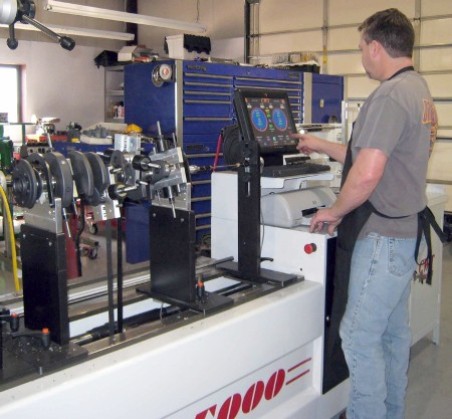
Bobweight
When a crankshaft is balanced, the actual rods and pistons cannot be
used in the balancing machine, so they must be simulated. This simulated
weight is called the "bobweight". Once the bobweight is calculated,
weights are bolted onto the rod journals to simulate the weight of the
rods and pistons during the balancing process. Due to the configuration
of a "V" type engine, just adding all the weights together does not
work.
There are also some dynamic considerations to be made when balancing the
crankshaft. Explaining those is beyond the scope of this discussion. If
you want to study those topics further, contact a crankshaft balancing
machine manufacturer and they can go into greater detail.
To calculate the bobweight of a particular assembly, the following
formula and balance card is used:
For example, let's say we are balancing a Chevy 383 with the following
component weights:
- Piston 416g
- Pin 118g
- Locks 2g
- Rings 35g
- Rod big end 458g
- Rod smal end 186g
- Bearings 46g
The rod weight is seperated into "big end" and "small end". This is
necessary because the small end has a reciprocationg (back and forth)
motion and the "big end" has a rotating motion. This split weight is
figured on a special scale fixture that supports one end of the rod
while weighing the other end.
There are several things to note about this calculation. The "oil" value
used on the left side of the calculation is an approximation of the
weight of residual oil "hanging around" on the assembly. The number used
here is a matter of preference. There is no solid "rule of thumb" for
this. Eagle uses 5g for small block assemblies and 15g for big block
assemblies. Since it is impossible to accurately represent this value,
it is just an estimate. The actual amount of oil can change constantly
and can even be different from cylinder to cylinder! We have found
through experience that the numbers we use estimate this property well.
The second thing to note is the 50% value used for the reciprocating
factor. This number deals with the geometry of the engine itself. A 90
degree bank angle "V" engine will use 50% here. A V6 or a narrow or wide
bank angle "V" engine will use a different value (again, consult the
balancer manufacturer). Some engine builders will perform what is call
"underbalancing" or "overbalancing". They will use slightly differnet
values here such as 48% or 52%. This is done to help compensate for
dynamic effects at extremely high or extremely low rpm operation (again,
beyond the scope of this discussion). Use 50% because this value
is required for almost all common street or racing engines.
Balanced Rotating Assemblies
Most rotating assemblies are sold unbalanced so that engine builders can balance it however they wish. Manufacturers do offer fully balanced assemblies balanced. But it must be ordered specifically as a balanced assembly.
Almost all High Performance Crankshaft are designed for internal balance. An internally balanced kit will not include a harmonic dampener or flywheel because they are not required for balancing – use whatever brand you like. Externally balanced kits will include a harmonic dampener and/or flexplate as needed. If a harmonic dampener and flexplate is provided, it will be an O.E. style replacement, not SFI approved. If you’re building a high horsepower engine, internal balance is preferred. Internal balance is better for longevity of parts and fatigue life.
